Inside everyone and almost everything is a deep history. An ancestral tree with steadfast roots that lead up to what you are now—and haute couture is no different. For centuries, the world has had a lustful eye for French fashion and a deep reverence for the people who make it. It has withstood so many eras and has been elevated by so many names; it’s no wonder it holds the platinum status that it does today. But haute couture—at least in the modern sense—wouldn’t have been possible without just as many names making themselves known and carving their own path in their respective times, and one of those names is Rose Bertin: premier fashion designer for the notoriously ill-fated Marie Antoinette.
Humble Beginnings
Opening her eyes on July 2, 1747, in Abbeville, Picardy, France, Marie-Jeanne Bertin—who ironically was never called Rose in her lifetime, but most likely Mademoiselle Bertin—was born to a rather poor family where she was the penultimate of seven children. Her mother was a nurse, a very lowly profession at the time, while her father worked at the local constabulary. After her father’s passing, the family relied heavily on her mother’s income to survive. It’s unclear as to how and when Bertin acquired the skill of sewing (although, coming from a fabric manufacturing town like Abbeville, she could have acquired it as young as nine), but it was obvious by age 16 that she was serious about her craft. And after snagging an apprenticeship with the successful Mademoiselle Pagelle, Bertin was introduced to members of the aristocracy, namely the Princesse de Conti, the Duchesse de Chartres, and the Princesse de Lamballe, all of whom aided in her eventual meeting with Marie Antoinette in the summer of 1774.
The Great Mogul
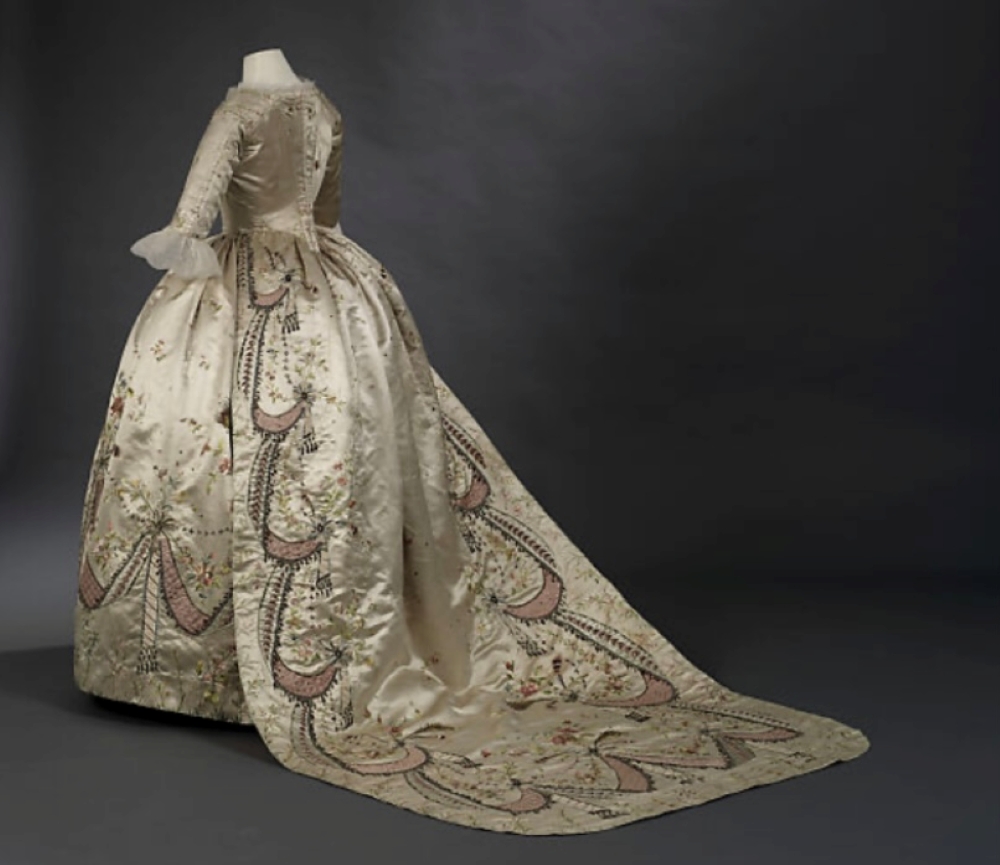
Bertin created her own shop, Le Grand Mogol, in 1770, and most of her wealthy clientele from Mademoiselle Pagelle transitioned with her. But it wasn’t until she started styling for Marie Antoinette that she and her business truly reached new heights. The new queen had asked Bertin to create the outfits for her coronation—which were insanely heavy due to the flood of jewels they contained—and was so smitten with them that she hired Bertin as what we would describe today as a personal stylist. The two ladies would meet twice a week to plan, edit, and discuss each “creation” Bertin had made for her, as well as sending mini doll-like versions called Pandora dolls (Pauper dolls for men) to Antoinette’s family back in Austria. This initiated Bertin into the French court (where she eventually earned the unofficial title of “Minister of Fashion”) as well as into Marie Antoinette’s inner circle. This golden ticket allowed Bertin to expand her name and influence; first in the French court, where she created and accelerated new trends (all through the fashionable queen, of course), and then later on an international level, where her dresses were sent all over Europe to foreign royals, further establishing French couture as a fashion of glorious repute.
A Slow Decline
The French Revolution changed everything. Especially for most of Bertin’s clientele. At first, orders simply lessened; the queen, who was used to buying the most expensive and extravagant gowns, now merely purchased irrelevant accessories (namely ribbons) and small alterations (though Bertin did design Marie Antoinette’s mourning dress after Louis VXI’s execution). Most of Bertin’s clients fled the country out of fear for their lives, while Bertin herself did her best to go about business as usual. She was able to avoid too much trouble with the revolutionaries by continuing to service her clients abroad—which did arouse a lot of suspicion for some time, even putting her on the list of émigrés at one point—before leaving for London in February of 1793. At this time, most of Bertin’s income didn’t come from any new creations, but from demanding unmade payments of old ones. And although she did return to France soon after, without the position and influence of the now late queen, Bertin never reached the heights of her former glory. And with the oncoming century, she passed what was left of her business down to her nephews before her quiet passing on September 22, 1813.
Rose Bertin’s impact, though shadowed, is quite clear. Her excellent and imaginative dressmaking played a crucial role in cementing the legacy of France’s most prominent royal. Her miniature models helped pave the way for one of today’s most famous toys, and her international appeal set a remarkable precedent for one of the world’s most glamorized art forms. While she may not technically be the first to do these things, she is one of the earliest models of the modern fashion designer, and remains one of the finest examples of French merit in fashion history.
Have you ever heard of Mademoiselle Bertin? Has her story opened your eyes to anything new? Let us know in the comments below.
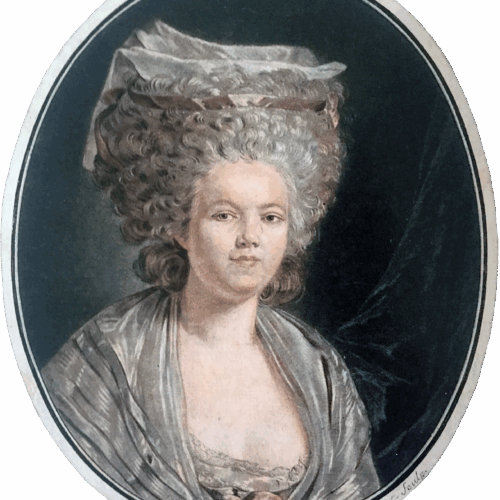
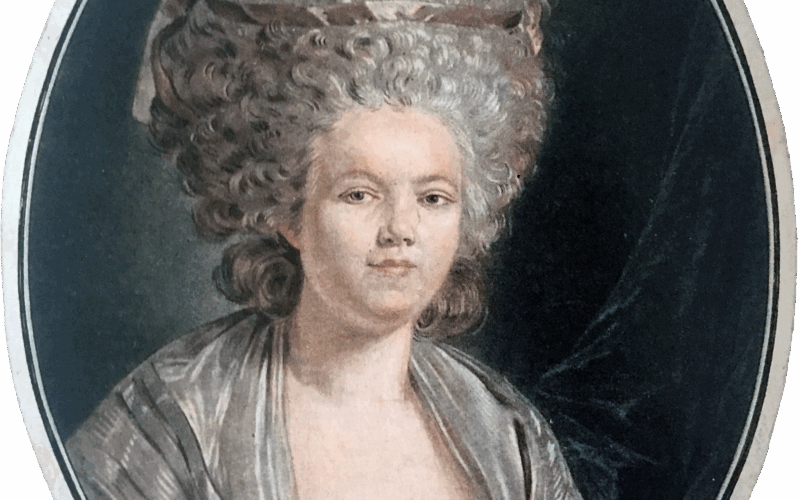
Cover image: Painting of Rose Bertin credited to Jean-François Janinet
XOXO,
Your Fashion Bestie